Decatur Tree Removal Pros plants and transplants trees across Decatur, AL, and the planting side of this trade is where the next thirty years of removal work is either created or avoided. Almost every hazardous tree we take down was planted by somebody, in a spot that made sense at four feet tall and made none at forty.
So planting here starts with mature size, not with what looks good at the nursery. What the tree will be when it is finished growing, what stands above and beside that spot, how far the roots will run, and what the ground underneath will actually support are the four questions worth answering before anybody digs. A species chosen against those answers needs almost nothing from us afterward.
This is oak-hickory country, with cedar glades on the shallow soils over limestone and deep, well-drained residual clay across most of the valley floor. That ground grows large hardwoods well, which is a reason to be careful: a species that thrives here will get big here, and the space it needs is the space it will take whether or not it was planned for.
Choosing a Species for This Ground
Mature Size Before Anything Else
The first question is not what you like, it is how much room the spot has when the tree is done growing — in height, in spread, and underground. A canopy tree twelve feet from a foundation, under a conductor, or over a septic field is a decision to pay somebody to manage it every few years. Getting this one right removes most of the maintenance the tree would otherwise need for its whole life.
Species That Suit the Valley Soils
Deep, well-drained residual clay over limestone across the valley floor suits the oaks and hickories that grow here naturally, along with a wide range of planted hardwoods. Bottomland closer to the river holds moisture and takes a different list, and the shallow soils over limestone are a genuinely restricted site rather than a slightly worse version of the good ground. The species list follows the spot rather than a regional catalog.
Diversity Over a Monoculture Street
A street or a property planted entirely in one species is one pest away from losing all of it at once, and this trade has watched that happen more than once. The Alabama Forestry Commission has confirmed emerald ash borer in Jackson and Madison counties in north Alabama, and southern pine beetle is the state’s own headline pest for unmanaged pine. Mixing the planting is the cheapest insurance available.
Planting Depth, Root Flare and Girdling Roots
The Root Flare Sits at Grade
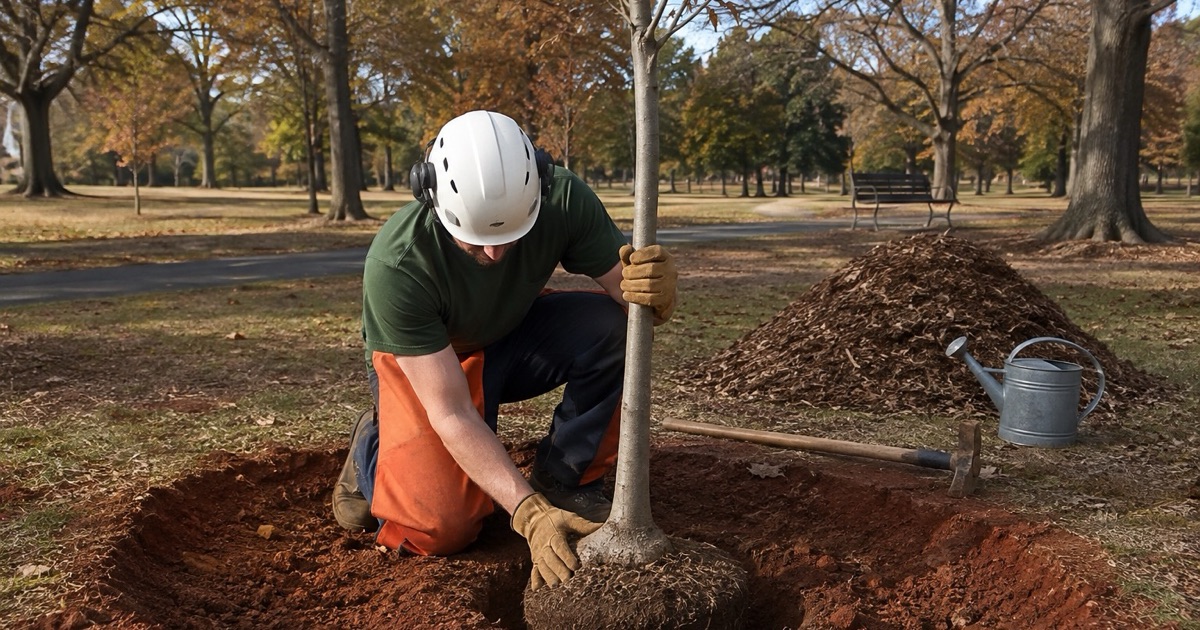
The flare where the trunk widens into the roots belongs at or slightly above finished grade, and it stays visible. Nursery stock is frequently potted or balled with soil already over the flare, so the first job on site is to find it in the root ball rather than to trust the top of the container. Planting to the container line is how a tree gets buried without anyone intending it.
Circling Roots Get Corrected at Planting
Roots that have spiralled inside a container do not straighten out on their own once they are in the ground; they keep circling and eventually girdle the stem they came from. Cutting and teasing them out at planting takes a few minutes and is the only moment it is ever easy. Left alone, the same problem is a root collar excavation and an air-excavation device ten years later.
The Hole, the Backfill and the Mulch
The planting hole is wide and shallow rather than deep and narrow, because roots run out rather than down. Backfill is the site soil the tree has to live in, not an imported pocket of something better that roots refuse to leave. Mulch goes on in a flat ring that never touches the trunk, at a depth that holds moisture without smothering the flare that was just set correctly.
Screens, Windbreaks and Spacing
The Screen Planted Too Tight
Every privacy screen is planted for the year it goes in rather than the decade after. Crowns pressed together hold moisture, air stops moving through the row, and disease travels from plant to plant with nothing to stop it. Leyland cypress is the local example — Seiridium canker moves through a tight row as brown flagging that becomes a permanent gap — and the Alabama Cooperative Extension System publishes spacing guidance worth reading before planting one.
Mixed Screens Fail More Gracefully
A row of a single species dies as a row. A mixed screen of two or three plants with similar habits loses individuals rather than the whole line, and the gap fills from both sides instead of standing open. It takes slightly longer to close in the first place, which is the entire reason people do not do it.
Transplanting and Aftercare
Moving an Established Tree
A transplant is a root-ball problem before it is a tree problem. The ball has to be proportioned to the trunk diameter, and it gets heavy fast, so what usually decides whether a move is possible is machine access at both ends rather than the tree’s own tolerance. Dormant-season moves succeed far more often, and a tree that has already been stressed is rarely worth the attempt.
Water Is the Whole First Two Years
A newly planted tree has the root system of a nursery pot and the canopy of a tree, and that mismatch is what kills it. Deep, infrequent watering through the first two growing seasons beats frequent shallow watering by a wide margin, and a slow soak at the root ball beats a sprinkler. Most planting failures we are called out to look at are watering failures with a species argument on top.
Staking, Guying and Taking Them Off
Most trees do not need staking, and the ones that do need it loosely and briefly. A trunk that can move builds taper and strength; a trunk held rigid does not, and comes off the stake weaker than it went on. The part that actually gets forgotten is removal — ties left in place girdle the trunk they were meant to protect, and that damage is permanent.
- 20+ Years in the Tennessee Valley
- Free Written Estimates
- Same-Day Storm Response