Decatur Tree Removal Pros does crane tree removal across Decatur, AL for the trees that cannot be dropped and should not be climbed: hardwoods standing over roofs, trees leaning across pools and driveways, storm-damaged wood with load still in it, and dead stems too brittle to trust a climber’s weight to.
The machine is a means, not a selling point. What a crane actually buys is control — a section is picked up before it is cut free, so the wood goes where the operator puts it rather than where gravity would. On a tree standing over a house, that difference is the entire job, and it is why crane work is usually the cheaper answer once the risk of the alternative is priced honestly.
What we will not do is quote a crane on a job that never needed one, or quote a machine that was never going to fit the site. Access is measured before the tree is priced — where the crane can set up, what the ground under the outriggers will carry, how far the load has to travel from the machine, and whether a tracked lift is the better answer for a back yard behind a gate.
When a Crane Is the Right Answer
Trees Standing Over a Structure
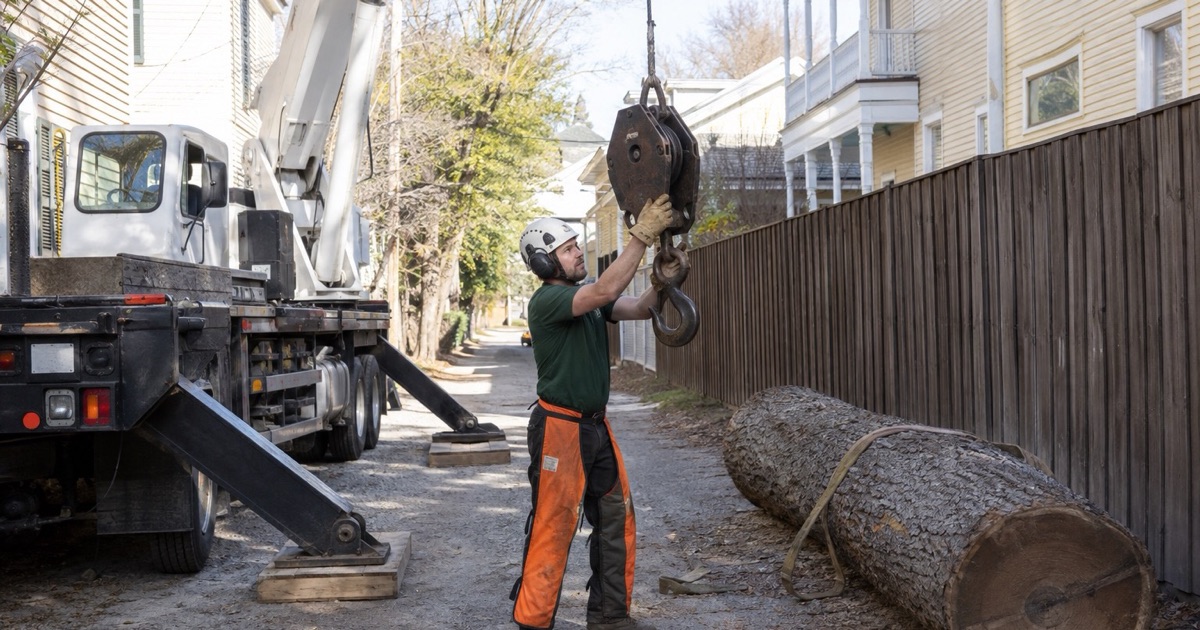
A large hardwood over a roof has no drop zone, and rigging every piece down through the canopy on a rope is slow, expensive and still leaves the load traveling across the structure. A crane lifts each section clear before the cut is finished, so nothing swings over the roof at all. It is the single most common reason a crane appears on an estimate here.
Dead, Decayed or Storm-Broken Wood
A climber’s safety depends on the wood holding, and dead ash, advanced decay and storm-broken stems are exactly the wood that does not. Where the trunk cannot be trusted to carry a climbing saddle and a rope, the answer is a machine that keeps people out of the tree entirely. Ash in particular goes brittle quickly once it dies, which moves a job into this category sooner than owners expect.
No Drop Zone at All
Some lots simply have nowhere for wood to land: a pool, a screened porch, a septic field, a neighbor’s fence four feet away, a driveway full of parked cars. Cutting small enough to hand-carry every piece out of a site like that is a multi-day job. Lifting the tree out over the top of it is a single day, and the yard looks the same afterward as it did before.
Setup, Reach and What Sets the Price
Where the Machine Can Sit
Setup position drives everything else. The crane needs firm ground, clear room for outriggers, and a working line to the tree that does not cross an energized conductor. That is usually a street or a driveway, occasionally a lawn on mats. Ten feet closer to the tree can change what the machine is able to lift, which is why this is the first thing measured rather than the last.
Radius, Capacity and Pick Size
A crane’s capacity falls as the load moves further out from the machine, so the same crane at a longer radius is a smaller crane. That relationship decides how big each pick can be, and pick size decides how many picks the tree takes and therefore how long the day runs. Working load limits are respected on rigging and slings the same way, without exception.
Ground Bearing and Protection
Outrigger loads concentrate a great deal of weight into a small footprint, so pads and mats go down as standard and the ground gets assessed honestly beforehand. A residential driveway is not always the right place to put a machine, and saying so at the estimate is cheaper for everyone than saying it afterward. Where the ground will not take it, the answer is another position or another method.
Tracked Lifts and Narrow Access
Spider Lifts Through a Gate
A tracked spider lift goes through openings a bucket truck cannot approach, tracks across a lawn without tearing it, and sets up on ground that would not carry a wheeled machine. For fenced back yards it is frequently the machine that makes the difference between an ordinary day and a hand-carry job, and it is quoted on the clear gate opening rather than the gate’s nominal width.
When Neither Machine Fits
Sometimes nothing gets in, and the honest version of that conversation happens before you have paid for anything. The tree comes down by sectional dismantling with a climber and rigging — a bull rope, a rigging block and a Port-a-Wrap friction device — and it takes longer and costs more. Quoting a machine that was never going to fit and discovering it at the fence line is the failure this whole approach exists to avoid.
The Day Itself
Picks, Rigging and the Sequence
The tree is taken apart in a planned sequence, from the top and from the side that unloads the structure first. Each section is slung and lifted before the cut is completed, so the piece never becomes free wood. The climber or lift operator and the crane operator work to agreed signals, and nothing is picked that has not been sized against the radius it is coming out at.
Where the Wood Goes
Sections come down into a landing zone rather than onto the yard, and from there they are processed the way the estimate said: bucked into rounds and hauled, bucked and left, chipped, or split for the homeowner. Crane days move a lot of wood quickly, so the disposal plan and the haul-away sentence matter more here than on almost any other job.
Protecting What Stays
The point of bringing a machine is that nothing on the ground gets hit, so the protection is planned as carefully as the picks: mats and pads under outriggers, plywood over anything crossed, screens and covers on windows, glass and vehicles moved, and utilities located before any ground-engaging work. Every removal here ends with the site cleaned down and the stump quoted as its own separate line.
- 20+ Years in the Tennessee Valley
- Free Written Estimates
- Same-Day Storm Response