Decatur Tree Removal Pros has handled emergency tree removal in Decatur, AL for 20+ years, serving surrounding cities including Hartselle, Triana, Athens, Madison, Huntsville. Storm and hazard calls are answered the same day, and the first thing you get on the phone is a straight answer about what happens tonight and what has to wait for daylight.
That honesty is the whole difference between an emergency crew and a sales call. There are conditions under which nobody should be in a tree, there are wires nobody should approach until a utility says so, and there are trees that are safest left exactly where they are until the wind drops. A company that promises to climb anything at any hour is describing a liability rather than a service.
What we can do in the dark is substantial: secure the site, cut a way out of a blocked drive, take weight off a structure at ground level with rigging, and set a plan for first light. The estimate that follows uses the same three lines as every other job here — takedown, stump, debris — with haul-away written in words rather than implied.
The First Hour After a Tree Comes Down
People, Power and a Perimeter
The order is people, then power, then property. Everyone comes out of the rooms under the tree and stays out; anything that looks like a wire is treated as live until the utility says otherwise; and a perimeter goes up well wider than the debris, because loaded limbs release without warning. Only then is it worth thinking about the roof, the car or the fence, none of which are going to get worse in the next ten minutes.
A Tree Resting on the House
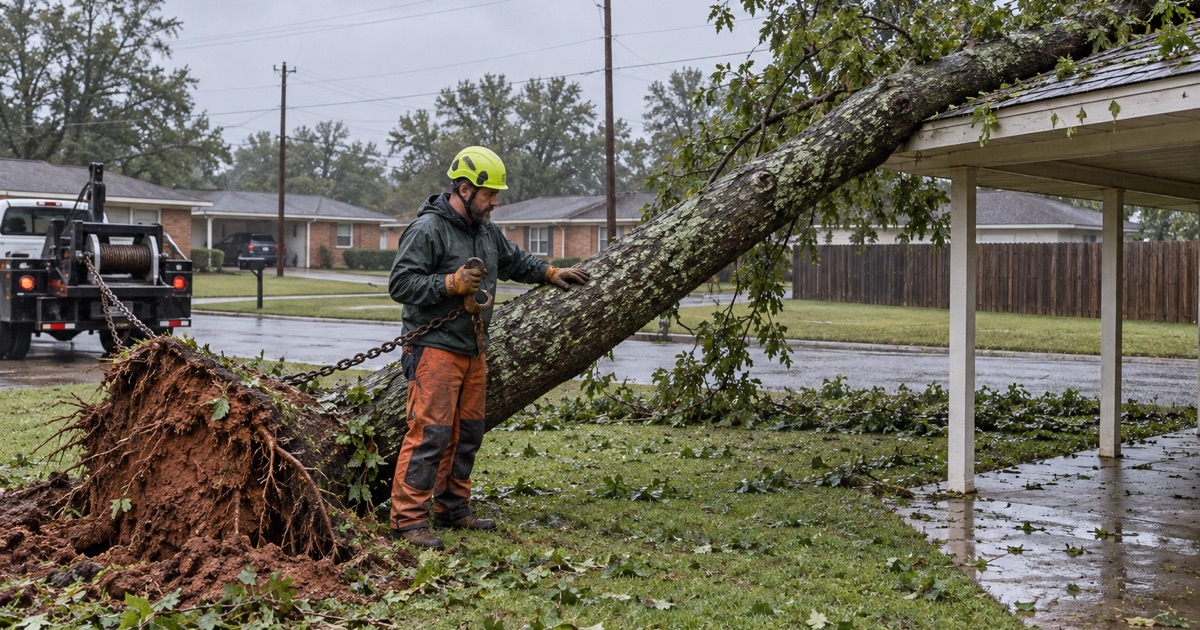
A trunk through a roof is a rigging problem before it is a removal. The load has to come off the structure in controlled pieces, lifted or held rather than pulled, because dragging it off tears the opening wider and can drop the rest of the tree into the hole. Our first pass looks for a service drop buried in the debris, finds where the weight is actually bearing, and sets a drop zone that does not run the wood back across the roofline.
A Tree Across a Drive, a Road or a Fence
A blocked driveway is usually the fastest thing to fix and the easiest to get wrong, because a trunk across a slope is under tension and compression at the same time and will move when it is cut. Debris in a public street or right of way is a city matter as well as a tree one, and in Decatur that call goes to Environmental Services and Solid Waste at 256-341-4740 rather than to a contractor.
Power Lines: Who to Call and Who Can Work
A Downed or Arcing Conductor
A conductor on the ground, in a tree, or arcing is a utility call and nothing else. Decatur Utilities publishes one instruction for it — stay away from all downed power lines — and the reporting number is 256-552-1400, option 1. No crew of ours approaches until the line is confirmed de-energized, and that is not a delay tactic; it is the reason tree workers are killed in this trade every year.
The Service Drop Between Pole and Weatherhead
The wire from the pole to the house is answered three different ways across this ring: one utility sends someone out to look at it, one will drop the line so a crew can work, and one treats the wire as entirely the homeowner’s problem. Which of those you are living under decides who you call first and how long the job takes, and we establish it before quoting rather than on the morning of the work.
The Limits on Working Near Energized Conductors
ANSI Z133, the safety standard for arboricultural operations, sets the electrical-hazard limits this trade works to, and it also covers weather. High wind, ice coming off a crown and active thunderstorms are the conditions under which climbing and aerial work stop. We tell you that on the phone rather than arriving, looking at the sky and leaving, and we say what we can do at ground level in the meantime.
Reading Storm Damage Before Deciding
A Lean, With or Without Soil Cracks
A lean by itself is not a verdict. The Alabama Cooperative Extension System’s post-storm assessment treats a lean accompanied by cracked soil and a mounded root plate as an immediate removal, and the same lean over undisturbed soil as a monitoring case. That means the ground around the trunk gets inspected before the tree does, and it is why a photograph of the canopy alone rarely settles anything.
Broken Limbs Against Stem Diameter
A break is judged against the diameter of the stem it came off rather than by how alarming it looks from the driveway. The state extension matrix monitors a break smaller than 30 percent of stem diameter, treats 30 to 50 percent as a prune-or-remove decision, and removes above that. Measuring is quick and it changes the answer often enough to be worth doing on every damaged tree rather than the obvious ones.
Bark Stripped From the Trunk
Bark torn away by a strike or by a falling neighbor is measured as a share of the trunk’s circumference. Half the circumference stripped is a removal on the same matrix; a narrow wound on an otherwise sound stem usually is not. The tree cannot move water through missing bark, so this is one of the few storm findings where the verdict can be reached with a tape measure and no equipment at all.
A Cracked Main Trunk
A crack running through the main stem is the storm finding with no second opinion, and the post-storm matrix calls for immediate removal. The stem has already failed and is standing on what is left of it, which is why a full green crown is not reassuring here. We will say so on the first visit, in writing, even when the tree looks untouched from the street.
Debris, Insurance and What Comes Next
What the City Will and Will Not Haul
Hiring anybody at all changes the answer, and this is the detail that surprises people after a storm. Decatur collects homeowner-cut limbs under 12 feet long and under 12 inches thick, unscheduled and roughly two weeks out — but the city requires contractors to haul debris from their own work sites and the Solid Waste Department will not take it. Our estimate states haul-away in words for exactly this reason.
Debris Removal Under a Homeowner Policy
Getting the wood off the ground is usually a separate allowance from repairing what the tree hit, capped on its own terms, and the Alabama Department of Insurance publishes consumer guidance on how those provisions read. Because the cap is generally written against the loss rather than per tree, several trees down in one night tend to share a single number — which is worth knowing before the wood is moved.
The Standing Trees the Storm Told You About
Most of what a storm does is reveal. A crown that shed one large limb, a root plate that lifted and settled back, a co-dominant union that opened under load — none of those came down, and all of them are now known problems. They get quoted as ordinary scheduled work at ordinary prices, which is always cheaper than the same tree handled as an emergency next season.
Our Step-by-Step Emergency Response
Step 1: The Phone Call and the Triage
The call establishes whether anyone is hurt, whether any wire is involved, what the tree is resting on, and whether the house is still safe to be in. If a conductor is in it, we route you to the utility first and stay on the problem after that call is made. You are told what can be done tonight and what genuinely has to wait for light, in plain terms.
Step 2: Make Safe on Arrival
The first work on site is a perimeter, a look for buried wires in the debris, and relieving load where a limb or trunk is bearing on something it should not be. Nothing gets cut for appearances in the dark. Tarping, boarding and blocking a drive are all reasonable night work; dismantling a canopy over a roof by headlight is not.
Step 3: Dismantle in Daylight, in Sections
The removal itself is sectional dismantling with rigging — a bull rope, a block and a Port-a-Wrap, or a crane or tracked spider lift where the piece sizes and the drop zone demand one. Every piece is lowered rather than dropped where a structure, a fence or a neighbor’s yard is underneath, and the rigging is sized to the load rather than to what happens to be on the truck.
Step 4: Debris, Documentation and What Is Left Standing
Brush is chipped and the wood is bucked and removed or stacked exactly as the estimate said. You get written notes and photographs of the tree’s condition for your adjuster, and a walk of whatever else on the property the storm has just made a candidate — with those trees quoted as scheduled work rather than folded into an emergency invoice.
- 20+ Years in the Tennessee Valley
- Free Written Estimates
- Same-Day Storm Response