
Decatur Tree Removal Pros has done stump grinding in Decatur, AL for 20+ years, serving surrounding cities including Hartselle, Triana, Athens, Madison, Huntsville. Stumps are quoted as their own line rather than folded into a takedown price, because the stump is the item two competing quotes most often disagree about and the one most often left in the yard by the cheaper number.
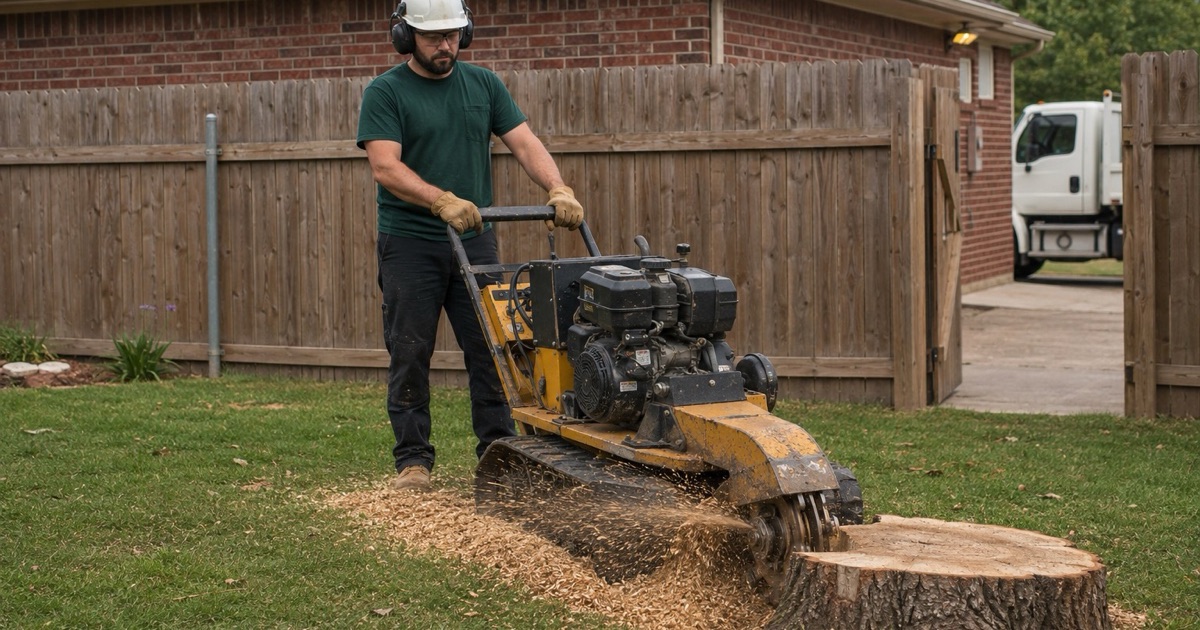
What a grinder does is narrower than most people assume, and saying so up front prevents the argument later. The machine cuts the stump and the buttress roots flaring off it into chips, to a depth we name on the estimate. The long lateral roots stay in the ground and decay over several years, and any job that genuinely needs them gone is stump excavation with different equipment and a different price.
The soil here changes the job more than the species does. Across this valley the dominant soils are very deep, so the grinder’s own rated cut is the binding limit rather than rock, while the chert-loaded ground up on the Rim does not stop a machine at all and instead eats its teeth. Both of those facts belong in a price before the work, not in an explanation afterward.
What Grinding Removes, and What It Leaves
Grinding Against Full Stump Excavation
Grinding turns the stump into chips and leaves the deep roots to rot in place. Excavation pulls the root plate out whole and leaves a hole the size of that plate, plus a machine track across the yard to get to it. Grinding is faster, cheaper and needs a fraction of the access, which is why it is the default on a finished lawn — and why excavation is still the right call ahead of a pool, a footing or a utility trench through the same ground.
Grinding Depth Below Grade
A cutting wheel reaches roughly 12 to 25 inches below grade depending on the machine’s class, and the depth that job actually needs comes from what goes on top afterward. Turf wants enough clearance for topsoil and root growth; a new tree in the same hole wants far more; a fence post or a paver in that spot is a different problem again. The estimate names a depth, so the finished hole can be checked against something.
Above-Grade Height and Surface Roots
The part above the ground is a separate decision from the part below it. A stump cut low by the takedown crew grinds faster than one left tall for a rigging anchor, and the surface roots radiating out from the flare are their own line — grinding them out to the edge of the lawn costs more than taking the stump alone, and leaving them means they stay visible under the grass for years.
Machines, Access and Ground Conditions
Narrow-Access Grinders and Fenced Yards
The question is never the gate’s nominal width, it is the clear opening once posts, latches, hinges and a sagging leaf have taken their share. Narrow-access and tracked machines fit through openings a towed grinder cannot, and where nothing fits, the answer is honest: hand removal, a section of fence panel out and reinstalled, or the stump stays. We measure the opening, the slope and the carry route before pricing rather than after.
Carbide Teeth and Chert Content
On Rim ground the constraint is abrasion, not refusal. Chert-loaded profiles here run from around 20 percent chert up toward 60 percent, and that gravel does not stop a cutting wheel — it wears the carbide teeth down through a job. A stump on that ground costs more to grind than the identical stump on clean valley clay, and it is quoted that way in advance instead of turning up as an unexplained line on the invoice.
Locates Before the Wheel Turns
Grinding below grade is excavation, so an Alabama 811 notice comes first and we place it. The shallow zone a grinder works in is exactly where irrigation lines, low-voltage lighting, invisible fence, and gas or electric runs out to a shop, a pool pump or a well tend to live. Private lines past the meter are outside the public locate, so anything a homeowner installed themselves needs marking before the machine is unloaded.
Grindings, the Crater and What Comes After
Chips Are Not Topsoil
The pile left behind is wood and soil mixed, and it behaves like wood. It settles as it decays, it ties up nitrogen while it does, and it will not grow grass on its own. Backfilling a grind hole with grindings alone is the single most common way a finished job turns into a slumped, bare circle by the next season, and it is avoidable by deciding the fill at the estimate.
Backfill, Seed and Sod
Restoring the spot is its own line and it says exactly what it includes: grindings raked back and mounded to allow for settling, or grindings hauled off and the hole filled with soil, then seeded or sodded. Mounding matters — a hole filled level on the day is a depression within months, and the mound is what makes the finished grade come out flat rather than dished.
Replanting Where the Stump Stood
Planting a new tree into an unprepared grind hole produces a tree that sulks for years, because the residual wood competes with it for nitrogen. The realistic options are grinding wider and deeper than the stump face and replacing the fill with soil, waiting a season before planting, or simply planting a few feet to one side. The last one is free, and on most lots it is also the best answer.
Residential and Commercial Stump Grinding
Yards, Fence Lines and Driveways
Residential stumps are usually about what goes there next: turf, a fence line that has to run straight through it, a shed pad, or a driveway widening. Each of those sets a different depth and a different tolerance for leftover roots, and each changes whether the grindings can stay on site. A stump beside a driveway apron or a slab edge also gets ground with the concrete in mind, because a wheel that reaches an edge will find it.
Parking Lots, Islands and Commercial Grounds
Commercial work is normally scheduled around traffic rather than around trees. Lot islands, medians and parking-lot perimeters mean curbs, irrigation heads, light bases and buried conduit within a few feet of every stump, and the grinding plan starts with locates and a protected work zone. Multiple stumps in one visit price differently from the same stumps on separate trips, because most of the cost of a small stump is getting the machine there.
Volume Work and Lot-Wide Grinding
A cleared lot, a fence line of old hedge stumps or a pasture with a dozen leftover stems is priced by the batch. Access, ground conditions and what happens to the spoil dominate that number, not the count — a dozen stumps on open ground with the grindings staying on site is a straightforward day, and the same dozen behind a gate with everything hauled out is not the same job at all.
Our Step-by-Step Stump Grinding Process
Step 1: Measure, Mark and Locate
The visit records stump diameter at the flare, the spread of surface roots, the clear gate opening, the slope and the carry route, and the 811 notice goes in. Anything private that will not appear on a public locate — irrigation, lighting, an invisible fence loop, a line to a shop — gets walked with the homeowner and marked.
Step 2: Protect the Work Zone
Grinding throws debris, so the area gets screened and anything that cannot take a hit is moved or covered: windows, siding, vehicles, gas meters, air conditioning units and neighboring fence panels. On commercial sites this is also where traffic control and pedestrian routing get set, before any machine is started.
Step 3: Grind to the Agreed Depth
The wheel works the stump down in passes to the depth named on the estimate, and the surface roots to the extent quoted. If ground conditions turn out to differ from what the site showed — a shallow pocket over rock, buried concrete, an unmarked line — the machine stops and you get a call, rather than a changed price at the end.
Step 4: Backfill, Haul or Leave
The spoil is handled the way the estimate said it would be: raked back and mounded, spread as coarse mulch away from trunks and beds, or loaded out. The work zone gets cleaned down, chips are blown off hard surfaces, and what is left is the finished grade you agreed to rather than whatever the machine happened to produce.
- 20+ Years in the Tennessee Valley
- Free Written Estimates
- Same-Day Storm Response