Decatur Tree Removal Pros has worked as an arborist in Decatur, AL for 20+ years, serving surrounding cities including Hartselle, Triana, Athens, Madison, Huntsville. The work is diagnosis and documentation rather than sawing: what is wrong with the tree, what it would hit if it failed, how likely that is, and what the realistic options are — written down, in a document that survives the conversation.
That work is sold on its own. A written tree risk assessment is a product with its own scope and its own price, quoted separately from any estimate to remove the tree, because a recommendation written by the crew that profits from it is worth less to everyone who reads it afterward. Homeowners, adjusters, builders, neighbors and property managers all end up reading these reports for different reasons.
The ground matters to the diagnosis here. Deep, well-drained residual clay over limestone across this valley lets mature hardwoods build a deep root plate, so the common failure mode on these soils is trunk decay and union failure rather than the wide, thin, whole-plate windthrow that shallow soils produce. That single fact changes what an inspection spends its time on.
What an Arborist Inspection Actually Covers
Root Flare, Root Collar and Root Plate
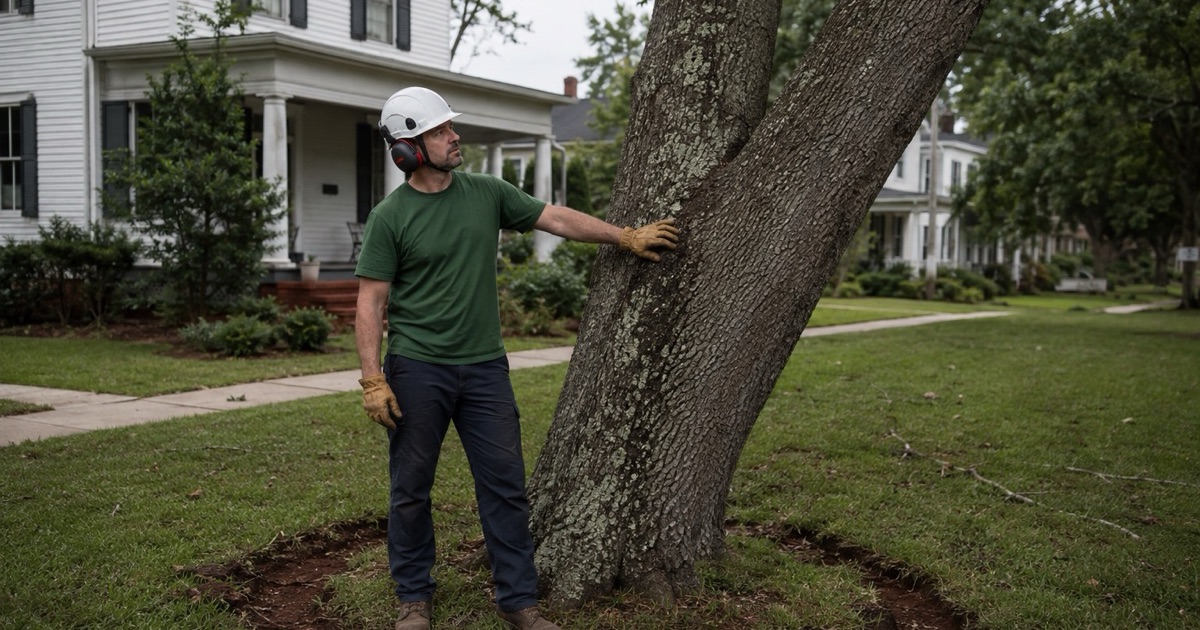
The inspection starts at the ground, because most of what kills a large tree happens below the mulch line. A buried root collar, girdling roots strangling the stem, a root flare conk or bracket fungus at the base, and a root plate that has lifted and settled are all findings that the canopy will not show for years. Where the flare is buried and the answer is not obvious, an air-excavation device blows the soil clear without cutting a single root, and the tree is inspected rather than guessed at.
Trunk Decay, Shell Thickness and Resistance Drilling
A cavity is not the number that matters; the shell of sound wood around it is. Sounding mallet inspection finds hollow wood by ear across the whole trunk quickly, and resistance drilling reads wood density along a thin path to show where a decay column begins and ends. Both are sampling methods rather than a cross-section, so a report we write says which points were tested and what the readings were, and stops short of claiming to know what the wood is doing everywhere else.
Unions, Included Bark and Co-Dominant Stems
Co-dominant stems that grew up competing rather than one leading the other frequently trap bark inside the union, and included bark is a seam rather than a joint — there is no wood connecting the two stems through it. On the deep valley soils where trees hold their footing, this union is where large hardwoods actually come apart. Reading it means looking at the angle, the bark pattern, the presence of a bulge or a crack, and how much weight each stem is carrying out over a target.
Tree Risk Assessment Reports and What They Are For
Named Targets and Stated Consequences
A risk assessment is not a grade out of ten. It names the target — the bedroom roof, the driveway where the cars park, the sidewalk, the neighbor’s shed — describes the failure that could reach it, estimates how likely that failure is, and states what happens if it occurs. The framework taught by the ISA Tree Risk Assessment Qualification is built on exactly that chain, and a report missing any link in it cannot be acted on by whoever receives it.
Screening, Basic and Advanced Assessments
The industry separates a limited visual screening of many trees from a basic ground-based assessment of one tree, and separates both from an advanced assessment that brings in resistance drilling, aerial inspection or root investigation. They cost different amounts because they take different amounts of time, and the useful conversation is which one the question deserves. A subdivision-wide screening finds the ten trees that need a proper look; it does not replace that look.
Reports Written to Be Read by Somebody Else
The audience changes the document. An insurance adjuster wants the failure described and dated; a neighbor dispute wants the tree’s condition established by somebody with nothing to gain from the outcome; a property manager wants a defensible record that the tree was inspected on a schedule. An ASCA Registered Consulting Arborist is the credential most often asked for on that last kind of work, and the reason is the same in every case — the reader is not the person who paid for the report.
Residential, Construction and Commercial Arborist Work
Homeowner Assessments Before a Removal Decision
Most homeowner calls are one tree and one question, usually after a storm or after a neighbor’s tree came down. The valuable outcome is often that the tree stays: a reduction to shorten a lever arm, a static or dynamic cabling system across a weak union, root collar excavation where a buried flare is the real problem, or a monitoring interval with a defined trigger to call back. Removal is a finding, not a default.
Construction Sites, Root Zones and Protection Fencing
Trees die from construction two or three years after the builder leaves, which is why nobody connects the two. Roots cut for a driveway, a trench, a pool or a pad are measured against trunk diameter and the critical root zone, and the answer decides whether a tree protection zone and construction fencing installed before the machines arrive would actually save anything. Fencing set after the grading is finished protects nothing but the appearance of having tried.
Inventories for Property Managers and Institutions
A site with dozens of trees is an inventory problem rather than a report problem. Every tree above a defined size gets located, identified, condition-rated and noted for defects, and the output is a list that supports a budget, a work schedule and a record of when each tree was last examined. Decatur is a manufacturing and river-port town with large plant campuses, schools and civic grounds, and those sites carry mature canopy over parking, walkways and loading areas.
Diagnosis and Plant Health Care in the Tennessee Valley
Southern Pine Beetle, Ips and Boring Dust
The Alabama Forestry Commission calls southern pine beetle the number one killer of pines in Alabama, and unmanaged loblolly and shortleaf stands are the susceptible ones. Under drought conditions the pitch tubes people look for can be very small or absent, leaving only reddish-brown boring dust in the bark crevices. Gallery shape settles the identification: S-shaped galleries under the bark indicate southern pine beetle, while Y- or H-shaped galleries indicate Ips engraver beetles, and the two situations call for different responses.
Hypoxylon Canker and the Stress Behind It
Hypoxylon canker on a hardwood is a report about the last few years rather than a disease that arrived on its own. It colonizes trees already weakened by drought, root damage, grade change or compaction, and by the time bark is sloughing off in sheets over the fungus the structural question has usually already been answered. That is why the inspection looks for the stressor — cut roots, a raised grade, a compacted lawn — instead of stopping at the symptom.
Ash, Emerald Ash Borer and Brittle Standing Wood
The Alabama Forestry Commission has confirmed emerald ash borer in Jackson and Madison counties in north Alabama, following earlier confirmations further south; Morgan County is not on that record, and we do not tell customers otherwise. What matters operationally is that dead ash goes brittle quickly, so a tree that could have been climbed this spring becomes a crane or tracked-lift job later, at a different price.
Our Step-by-Step Tree Risk Assessment Process
Step 1: The Question and the Target
The visit starts with what you are actually worried about and what stands underneath it, because that is what the assessment is measured against. A leaning tree over an open pasture and the same tree over a child’s bedroom are different findings from identical wood, and any report that does not begin here ends up answering a question nobody asked.
Step 2: Ground-Up Inspection
Root flare, soil, root plate, trunk, unions, then crown, in that order and on foot around the whole tree. Species, diameter at breast height, defects, fungal fruiting bodies and evidence of previous work all get recorded on site rather than reconstructed later, and photographs are taken of anything the written finding will depend on.
Step 3: Measurement Where It Is Warranted
Sounding, resistance drilling, root collar excavation or an aerial inspection get added only where the ground-based read leaves a real question open. Each one has a cost and each one is quoted before it happens, so an advanced assessment is a decision you make rather than a line that appears afterward on an invoice.
Step 4: The Written Report and the Options
The document names the tree, the defect, the target, the likelihood and the consequence, then lays out every option that survives the findings — removal, reduction, cabling and bracing, root work, or monitoring on a stated interval with a defined trigger. If removal is the answer, the estimate to do it is a separate document, priced the way every other job here is priced.
- 20+ Years in the Tennessee Valley
- Free Written Estimates
- Same-Day Storm Response